CBSE · Exam preparation
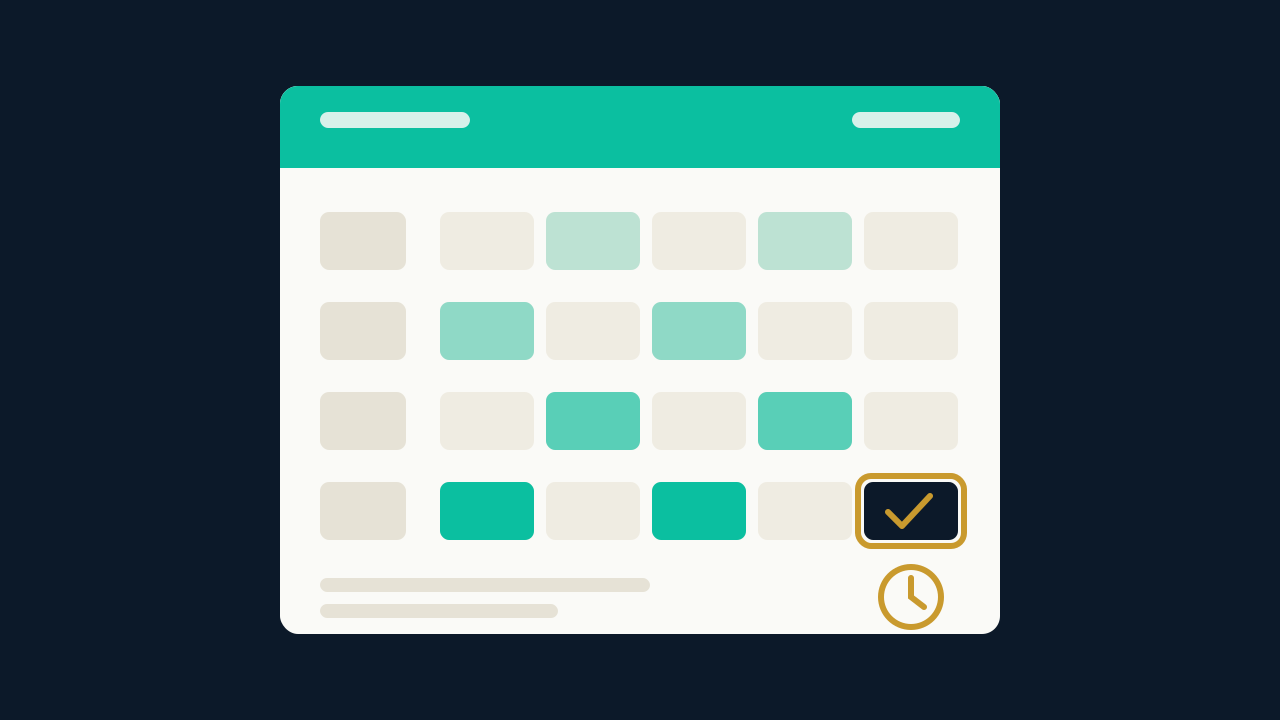
Half-yearly exams in Classes 6 to 8 are set by the school, not by CBSE, and most schools hold them in September or October. The study timetable that actually works starts about four weeks out, runs roughly forty-five minutes an evening, and spaces every topic so it is practised twice, about ten days apart.
When are the half-yearly exams in Classes 6 to 8?
Whenever your child's school says. CBSE publishes no half-yearly date sheet for Classes 6 to 8, so each school fixes its own dates and announces them by circular, usually four to six weeks ahead. September is the common window, and it moves by a fortnight in either direction.
Two published school schedules show the spread. Bal Bharati Public School's examination plan for 2026-27 puts Periodic Test 1 in May and names 1 September 2026 as the tentative commencement date for the half-yearly. North-Ex Public School ran its Classes 3 to 8 half-yearlies from 10 to 26 September 2025, with results on 11 October.
So if it is early August and your child is in Class 6, 7 or 8, you are almost certainly four to eight weeks out. That is the whole planning window, and it is more than enough if you use it deliberately instead of waiting for the date sheet to arrive.
One thing worth doing today, before any timetable: find the school circular that lists the portion. Everything below assumes you know which chapters are actually being examined.
Does CBSE fix the half-yearly paper for Classes 6 to 8?
No, and this is where most guidance online is quoting a rule that no longer exists. CBSE did fix it once. Circular Acad-14/2017 built Classes 6 to 8 around two terms of 100 marks each, with an 80-mark half-yearly plus 20 marks of periodic assessment. Ten months later the board took it back for those classes.
"As per the decision of the Governing Body of the Board taken in its meeting held on December 15, 2017, the circular no Acad-14/2017 dated 21/03/2017 on the subject cited above stands repealed to the extent it applies to classes VI to VIII."
CBSE notification, 22 January 2018
The repeal followed an objection from the National Commission for Protection of Child Rights, which held that examinations in the elementary classes sit under the Right to Education Act rather than with the board. As of August 2026, CBSE's academic circular archive shows no replacement scheme for Classes 6 to 8.
What survives is habit. Most schools still run something close to the old shape, because it lines up neatly with Classes 9 and 10, where the 2017 scheme does still apply. Many also keep its rule that the year-end paper carries part of the first term forward: 10% in Class 6, 20% in Class 7, 30% in Class 8.
Two practical consequences. The marks, the duration and the portion for your child's half-yearly come from the school's circular, not from a board rule you can look up. And a chapter fumbled in September is likely to reappear in March, so this exam is worth treating as information rather than as a verdict.
How early should a half-yearly study timetable start?
About four weeks out, with each topic practised twice and roughly ten days between the two passes. The gap is not a guess. In Cepeda and colleagues' 2008 study in Psychological Science, over 1,350 people learned a set of facts, revisited them after varying gaps, and were tested later. For a test 35 days away, the best gap was 11 days, and recall at that gap was 59% higher than for people who revisited immediately.
Classroom research agrees. A 2025 meta-analysis of applied studies covering 22 studies and more than 3,000 students found a moderate advantage for spaced over massed practice (d = 0.54). Practising by answering questions rather than rereading adds a second, separate gain: reviews of the testing effect put it at 0.50 to 0.61.
Put together, they describe the enemy precisely. It is not too little revision. It is revision compressed into the last four nights, where the gap between passes is close to zero and most of the benefit disappears.
The plan below is built to hold that shape: find the weak topics in week one, practise them in week two, come back to those same topics in week three, then rehearse the whole paper in week four.
What does a four-week half-yearly timetable look like?
| When | What the week is for | A typical evening, about 45 minutes |
|---|---|---|
| 4 weeks out | Find the gaps. Get the portion list, then have your child attempt a short mixed set from each chapter, untimed, on paper. This is a survey, not a test. | 6 to 8 questions from one subject, checked together afterwards, wobbly topics written on a list |
| 3 weeks out | First pass on the two or three shakiest topics only. Leave the solid chapters alone. | One topic, 8 to 10 questions, then re-do the ones that went wrong |
| 2 weeks out | Second pass on those same topics, roughly ten days after the first. Add the next-weakest topic. | Fresh questions on an old topic first, then the new one |
| 1 week out | Rehearse the paper, not the chapters. One timed full-length attempt, then errors only. | Mixed questions across chapters, timed, marked strictly |
Two rules make it work. Practise on paper, in writing, because that is the format the exam uses and it is the only way slips show up. And keep the weekend sessions to the same length as weekday ones: a four-hour Sunday is exactly the massed practice the research says to avoid.
If your child studies three subjects for the half-yearly, rotate them across the evenings rather than stacking a subject a week. Rotation is what creates the gaps.
How long should each evening be, and what about sleep?
Shorter than most parents fear. NCERT's School Bag Policy 2020 sets the benchmark for this age group:
"Middle School (from Classes VI-VIII): A maximum of one hour a day (about five to six hours a week)."
That hour is meant to cover homework. Exam practice has to fit alongside it, not on top of it, which is why the timetable above asks for about 45 minutes and asks for it on paper rather than in front of a screen.
Sleep is the other boundary, and it is not negotiable in the last week. The American Academy of Sleep Medicine recommends 9 to 12 hours per 24 hours for children aged 6 to 12, and 8 to 10 hours for 13 to 18 year olds. Classes 6 to 8 straddle that line. A Class 7 child studying until midnight the night before a paper is trading away the consolidation that makes the previous three weeks count.
The honest version of a study timetable for Class 6, 7 or 8 is therefore modest: about 45 minutes on most evenings, one longer timed attempt in the final week, and a normal bedtime throughout. If the plan needs more hours than that, the problem is usually that the practice is unfocused, not that there is too little of it.
What should the last week before the paper look like?
One full-length timed attempt, then nothing but errors.
- Six or seven days out: a mixed paper across all the chapters in the portion, in one sitting, timed to the length the school circular states. Phones away, rough sheet allowed.
- The days after it: mark it strictly, then sort every wrong answer into three piles. Careless slips, genuine misconceptions, and blanks. The piles matter more than the total, and we go through how to read them in how to read your child's worksheet.
- Two days out: re-do only the questions from the misconception pile, using fresh questions on the same skills rather than the same questions again.
- The night before: stop early. A quick look at the error list, then close the books.
Resist the urge to add a new chapter in the final week. Anything genuinely unlearned in September is better handled after the paper, when it can be practised properly, than crammed the night before and forgotten by the exam hall.
What do you do when the paper comes back?
Read the mistakes, not the mark. A half-yearly is the year's first substantial, timed sample of what your child can do under pressure, and it is far more useful as a diagnosis than as a score. Sort the errors the same way as in the mock, pick the single misconception that matters most, and practise that one skill for a fortnight before checking it again with fresh questions. That habit is what turns each exam into a correction rather than a verdict, and it is the same habit that makes the PT1 periodic test worth reading properly earlier in the year.
If you want the finding-and-tracking part handled for you, that is what LearnAlice is built for. You choose a topic, or photograph the textbook page the portion covers, and it prints a board-aligned practice worksheet in the vocabulary your child's syllabus already uses, from Class 7 Maths to Class 8 Science. Graded answers build a skill-by-skill picture over the term, marked simply as Mastered, Still developing, or Not practised yet. LearnAlice does not teach or replace the school. It tells you where your child actually stands, so the next four weeks aim at something.
FAQ
When are CBSE half yearly exams for Class 6, 7 and 8 held?
There is no CBSE-wide date sheet for these classes. Half-yearlies are school examinations, and schools commonly hold them between early September and mid-October, announcing dates by circular four to six weeks ahead. Two published 2025 and 2026 school schedules place them in September. Your school's circular is the only reliable source.
How many marks is the half yearly exam in Classes 6 to 8?
Whatever the school sets. The familiar 80-mark half-yearly plus 20 marks of internal assessment came from CBSE Circular Acad-14/2017, which the board repealed for Classes 6 to 8 in January 2018. Many schools still follow that shape by convention, but it is now school policy rather than a board rule.
How many hours a day should a Class 7 child study for half yearlies?
About 45 minutes of focused practice on most evenings, spread over four weeks, beats several hours crammed into the final week. NCERT's School Bag Policy 2020 caps recommended homework for Classes 6 to 8 at one hour a day, and exam practice should sit inside that budget rather than on top of it.
Is it too late to start if the exam is two weeks away?
No, but the plan changes. With two weeks, run one diagnostic session on day one, spend the middle stretch on the two weakest topics only, and keep one timed full-length attempt for six days out. Drop the ambition to cover everything and aim at the specific topics the diagnostic exposes.
Want practice papers for exactly the chapters in your child's half-yearly portion? Start a 14-day free trial, photograph the chapter, and print one tonight. No card, cancel anytime.
CBSEExam preparation
Worksheets are the input. Clarity is the output.
LearnAlice turns every worksheet your child completes into a clear picture of what they've mastered, what's still developing, and the one thing to practise next — in your school board's own language.
Start free trial14 days free per child · no card needed