Cambridge · Exams · Parenting
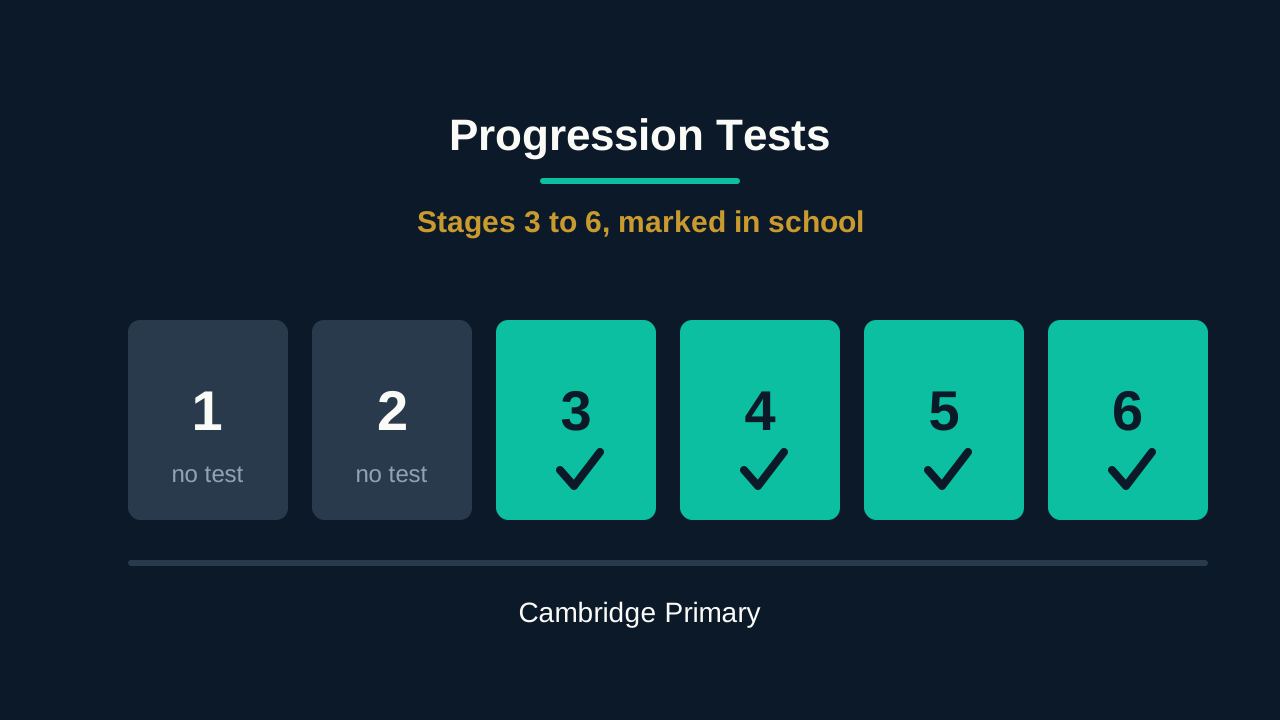
A Cambridge Primary Progression Test is an internal school test. Cambridge writes it, your child's own teachers mark it, and no external body ever sees the score. Tests exist for Stages 3, 4, 5 and 6, which is 4 of 6 primary stages, in English, English as a Second Language, mathematics and science. There is no fixed exam date.
What is a Cambridge Primary Progression Test?
It is a ready-made test paper that Cambridge supplies to registered schools, and that the school runs and marks itself. Cambridge is direct about the arrangement:
"Available for our core subjects, English as a first or second language, mathematics and science, progression tests are marked by teachers in your school and available for stages 3, 4, 5 and 6." Source: Cambridge Primary assessment (Cambridge International Education, as of August 2026)
Three things follow from that, and all three matter to a parent.
The result is not a qualification. Nothing is recorded outside the school, no certificate is issued, and no future school or university will ever ask for it. Compare that with Cambridge Primary Checkpoint, which is marked by Cambridge itself and produces a Statement of Achievement.
The paper is standardised, the marking is local. Your child sits the same test as children in other Cambridge schools, but a teacher in the building applies the mark scheme. Cambridge supplies the guidance, standards and mark schemes with the papers.
The test is optional for the school. Cambridge describes its assessments as recommended rather than required, so schools choose which ones to use. If your child's school has never mentioned a progression test, that is a legitimate choice, not an oversight.
Progression tests continue past primary. Cambridge Lower Secondary has its own set for Stages 7, 8 and 9 (Cambridge Lower Secondary Progression Tests, as of August 2026), so across both programmes a test exists for 7 of 9 stages.
When does my child sit a progression test?
Whenever the school decides. This is the single biggest difference from Checkpoint, and the reason searching for "progression test dates" returns nothing useful.
Cambridge sets no timetable at all:
"Use them to check learners' progress at any time of year, as many times as needed, throughout Stages 3, 4, 5 and 6 of Cambridge Primary." Source: Cambridge Primary brochure (Cambridge International Education)
In practice most schools run them near the end of the academic year, which is what Cambridge suggests on its assessment page. Some run them mid-year as a check, and some run them twice.
One date does exist, and it is easy to misread. Cambridge releases a fresh set of papers to schools each January, and the tests have been updated annually since 2022. Its own FAQ puts it this way: "Progression tests will still be available for schools every January" (Checkpoint updates FAQs, as of August 2026). That January is when the school can download the new papers, not when your child sits them.
Checkpoint works the opposite way. Since 2026 every Checkpoint subject sits on a date Cambridge fixes, and a child who misses it cannot take it another day. Our guide to the Cambridge Checkpoint dates for 2026 and 2027 has the full timetable.
So if the school has not told you a date, there is nothing to look up. Ask the class teacher directly: which term, which subjects, and will the marked paper come home.
Why can I not find official past papers?
Because Cambridge limits them deliberately, and the sites that appear to offer them are not Cambridge.
Search "progression test stage 4 past papers" and the results are document-sharing sites, blog reposts and paid bundles. The official papers sit behind a school login on the Cambridge Primary support site, which only registered Cambridge schools can access.
Cambridge explains the scarcity in its own words:
"We have a limited number of practice tests to ensure that the Checkpoint and Progression Tests remain effective tools for measuring a student's potential and progress. Repetitive testing of students does not support the purpose of these tests and can undermine their ability to provide valuable information to teachers." Source: Where can I find more Primary Checkpoint and Progression Test past papers? (Cambridge International Education, as of August 2026)
That is worth reading twice. Cambridge is saying that drilling a child on past progression papers damages the thing the test is for. The test is a measuring instrument, and a child who has already done the paper cannot be measured by it.
The practical route for a parent is not to hunt for the paper. It is to practise the stage's actual learning objectives, which Cambridge publishes openly in the curriculum framework, and let the test do its job unrehearsed.
Why is there no progression test in Stage 1 or Stage 2?
Because Cambridge judges those children too young for a written test, and says so plainly.
"Cambridge believes learners in stages 1 and 2 are too young for written examinations. For this reason, we do not produce Progression Tests for these stages." Source: Why are there no Progression Tests for stages 1 or 2? (Cambridge International Education, as of August 2026)
Cambridge adds that teachers should instead get to know their learners and give regular, targeted feedback. If your child is in Grade 1 or Grade 2 at a Cambridge school, there is no Cambridge test in their year, and no external assessment of any kind until the end of Stage 6.
Some schools still run their own internal assessments in those years. Those are the school's papers, not Cambridge's, and they are worth asking about separately.
Which subjects have a progression test?
Four test papers across three subject areas: English as a first language, English as a Second Language, mathematics and science. Nothing else.
Cambridge deliberately excludes the rest, and the reason is assessment load:
"There are no Cambridge Primary Progression Tests for Art and Design, Music, Physical Education, Digital Literacy, Modern Foreign Languages, Humanities, Computing or Wellbeing, as research shows that an assessment overload for learners of this age can be detrimental." Source: Are there Progression Tests for all subjects? (Cambridge International Education, as of August 2026)
Those subjects are assessed in the classroom instead, through discussion, observation and lesson outputs. So a report card comment on your child's music or PE will not be sitting on a test score, and it was never meant to.
What should I do with the result?
Read it as a map of gaps, not as a verdict. Cambridge is explicit that the results are formative, meaning they exist to tell a teacher what to reteach rather than to rank a child.
Cambridge lists the intended uses: identifying strengths and weaknesses in individual learners or groups, tracking progress over time, reporting back to learners and parents, and reflecting on teaching in the school.
Two questions get you everything useful out of a progression test result:
- Which topics did my child lose marks on? Not the total, the topics. A 68 percent that is evenly spread means something completely different from a 68 percent with fractions at zero.
- What is the school doing about those topics? The test was designed to trigger reteaching. Ask what changes in class as a result.
If the marked paper does not come home, ask for it. The paper is where the diagnosis lives, and the number on the report card is a summary of it.
Our guide to reading your child's worksheet covers how to spot the difference between a topic gap and a careless-working gap in a marked script.
How do I practise a specific Cambridge stage at home?
Practise the stage's published learning objectives, not the test format. The Cambridge Primary Mathematics framework (0096) and Science framework (0097) are written stage by stage and name every objective, so you can work directly from the same list the test is built against.
Two cautions before you buy anything. A worksheet pack that does not name the framework it maps to is usually mapped to nothing. And a pack sold as "progression test practice" is almost always a scraped past paper, which is exactly the material Cambridge says not to drill.
LearnAlice is a diagnostic instrument, not a tutor. It does not teach your child. It prints practice worksheets built from a stage's real learning objectives, grades the answers your child writes on paper, and reports back in three states: Mastered, Still developing, and Not practised yet. The Grade 4 (Stage 4) Cambridge maths worksheets match the year most parents ask about, and the Grade 3 (Stage 3) Cambridge maths worksheets cover the first year a progression test exists.
If the stage number itself is the confusing part, our guide to Cambridge grades, stages and years sorts out which word means what.
FAQ
Is the Cambridge Primary Progression Test an official exam?
It is an official Cambridge test paper, but not an official examination. The school runs it and its own teachers mark it, and the result stays inside the school. No certificate is issued and no external body records the score. The only externally marked Cambridge primary assessment is Checkpoint, at the end of Stage 6.
What stages have Cambridge Primary Progression Tests?
Stages 3, 4, 5 and 6, which is 4 of 6 Cambridge Primary stages. There are none for Stages 1 and 2, because Cambridge considers children of that age too young for written examinations. Cambridge Lower Secondary then has its own progression tests for Stages 7, 8 and 9.
Where can I download Cambridge progression test past papers?
Only a registered Cambridge school can, from the Cambridge Primary support site. Cambridge limits the number of practice papers on purpose, so the tests keep working as a measure. The past-paper sites that rank in search results are third-party reposts, not Cambridge, and their papers are often years out of date.
Does the progression test affect my child's report card?
That depends entirely on the school, because the test is internal. Some schools fold the score into a term grade, some report it separately, and some use it only to plan teaching. Ask the class teacher how your child's school treats it, since Cambridge sets no rule on this.
How should my child prepare for a progression test?
By practising the stage's learning objectives through the year, not by drilling past papers. Cambridge states that repetitive testing undermines what the test can tell a teacher. Steady topic practice, with someone checking the working rather than only the answers, is both more useful and more honest.
A progression test is the school checking its own teaching, using a paper Cambridge wrote. Treat the marked script as information about what to practise next, and ask for it if it does not come home.
CambridgeExamsParenting
Worksheets are the input. Clarity is the output.
LearnAlice turns every worksheet your child completes into a clear picture of what they've mastered, what's still developing, and the one thing to practise next — in your school board's own language.
Start free trial14 days free per child · no card needed