Cambridge · Parenting · Curriculum
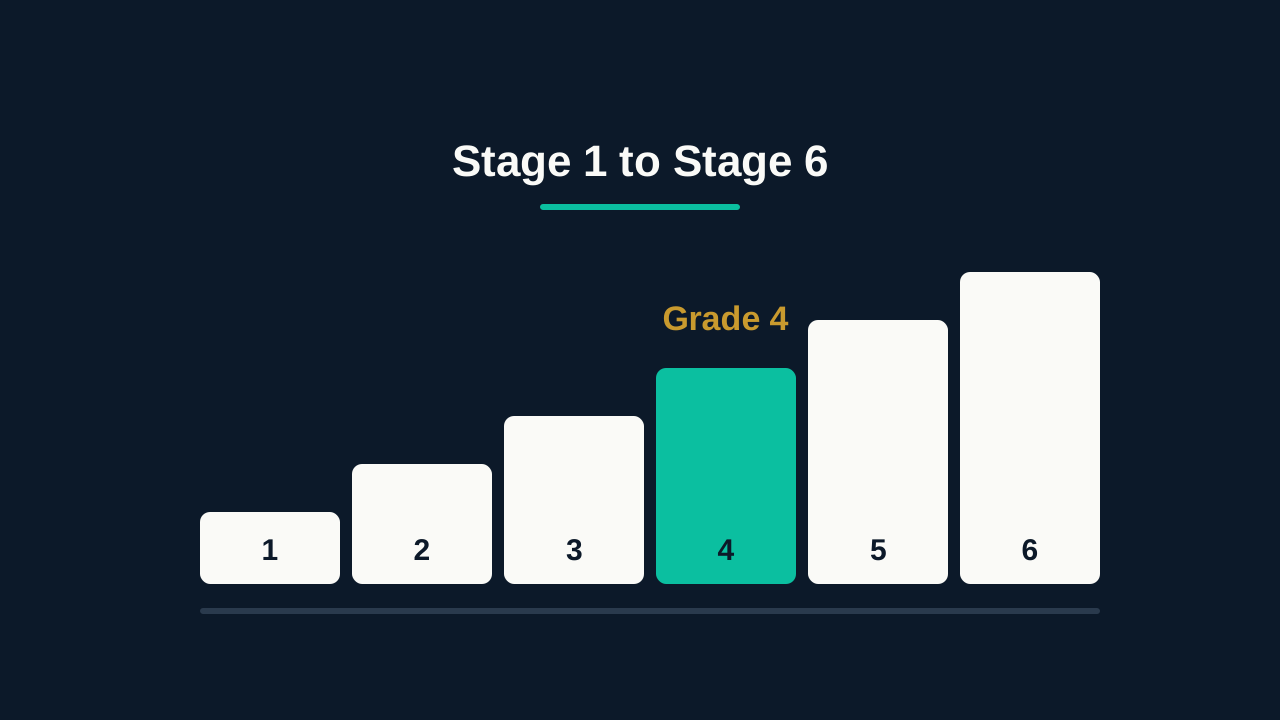
If your child is in Grade 4 at a Cambridge school, the curriculum document behind that year is called Stage 4. Cambridge writes its curriculum in stages, most schools in India and the UAE talk to parents in grades, and many textbooks are titled by year. In practice the numbers usually line up, so Grade 4 work is Stage 4 work.
Grade, stage or year: which word is which?
Three words, three different owners, and only one of them is official.
- Stage is Cambridge's own word. Every curriculum framework, progression test and support document uses it. Cambridge Primary runs from Stage 1 to Stage 6.
- Grade is what most Cambridge schools in India and the Gulf actually print on the report card and say at the gate. It is a school naming convention, not a Cambridge term.
- Year usually comes from the textbook cover or from British schooling habits, where year groups are numbered the same way.
For nearly every Cambridge school in India and the UAE, Grade 4 means Stage 4 material. The one case worth checking is a school that uses American-style grade naming, where a grade number can sit roughly a year apart from the Cambridge stage of the same number. Ask the class teacher which stage the maths and science schemes of work are drawn from. That single question removes all the ambiguity, and it is the number you need before buying any practice material.
What does each Cambridge Primary stage cover?
Cambridge Primary is a six-stage programme. The official framework for mathematics, Cambridge Primary Mathematics (0096), is written stage by stage, and so is Cambridge Primary Science (0097).
| Stage | Commonly called | Typical age |
|---|---|---|
| Stage 1 | Grade 1 | 5 to 6 |
| Stage 2 | Grade 2 | 6 to 7 |
| Stage 3 | Grade 3 | 7 to 8 |
| Stage 4 | Grade 4 | 8 to 9 |
| Stage 5 | Grade 5 | 9 to 10 |
| Stage 6 | Grade 6 | 10 to 11 |
Cambridge deliberately does not lock a stage to an age. The framework describes itself as suitable for a span of learners, and schools are told they may place children a little either side of the typical age.
The framework is "typically for learners aged 5 to 11," and Cambridge notes it may be used for slightly different ages to suit a school's context. Source: Cambridge Primary Mathematics Curriculum Framework 0096, version 1.1 (UCLES, September 2020)
The same document sets teaching time at 4 to 5 hours of mathematics a week, roughly 120 to 150 hours per stage. If your child's school covers noticeably less, that is a fair question to raise at the next parent meeting.
When does my child actually sit a Cambridge exam?
Less often than most parents assume, and for most of primary the answer is never.
Cambridge Primary Progression Tests are available for Stages 3, 4, 5 and 6, so 4 of 6 primary stages. These are internal. They are marked by teachers inside your child's own school, and no external body sees the result. Nothing external exists for Stages 1 and 2 at all. Our guide to Cambridge Primary Progression Tests for parents covers when schools run them and why the official papers are so hard to find.
Cambridge Primary Checkpoint is the external one. It is marked by Cambridge, and it is taken at the end of the Cambridge Primary programme, which means Stage 6 only. Schools enter for one of three test series a year, in March, May or October, and since 2026 each subject sits on a date Cambridge fixes rather than in a window the school picks. Our guide to the Cambridge Checkpoint dates for 2026 and 2027 lists every test day. Learners receive a Statement of Achievement and the school receives a diagnostic feedback report (Cambridge Primary assessment, as of August 2026).
So if your child is in Grade 3 and someone mentions "the Cambridge exam," they almost certainly mean an internal progression test set and marked by the school itself. There is no external Cambridge examination before the end of Stage 6.
What happens after Stage 6?
Stage 6 is the end of Cambridge Primary, not the end of the stage numbering. Cambridge Lower Secondary picks up at Stage 7 and runs to Stage 9, and it is described as typically for learners aged 11 to 14 (Cambridge Lower Secondary, as of August 2026). A second Checkpoint sits at the end of Stage 9.
That continuity is why the stage number matters more than the grade label. A child moving between Cambridge schools, or between countries, carries a stage, and the stage is what the next school's scheme of work is built on.
How do I practise a specific Cambridge stage at home?
Buy or print by stage, not by age, and check the strand names before you commit. Cambridge Primary Mathematics is organised into Number, Geometry and Measure, and Statistics and Probability, plus Thinking and Working Mathematically running across all of them. A worksheet pack that does not name the framework it maps to is usually mapped to nothing.
LearnAlice publishes practice pages for Cambridge Maths and Science across Stages 1 to 6, which is 12 of 26 board pages on the site. Each one lists the actual Learning Objectives for that stage, so a parent searching for Grade 4 material can confirm the content before printing. The Grade 4 (Stage 4) Cambridge maths worksheets are the direct match for the year most parents ask about, and the Grade 6 (Stage 6) Cambridge maths worksheets cover the Checkpoint year.
One caution on vocabulary. Cambridge calls them Learning Objectives, while a CBSE report card calls the equivalent Learning Outcomes. If your child has moved between the two systems, the words on the two report cards are not interchangeable. Our guide to what "mastered" and "still developing" mean unpacks the progress labels that sit on top of either framework.
FAQ
Is Cambridge Grade 4 the same as Stage 4?
In almost every Cambridge school in India and the UAE, yes. Grade is the school's label and Stage is Cambridge's official term for the same year of the curriculum. The exception is a school using American-style grade naming, where the numbers can sit about a year apart, so confirm with the class teacher.
Is there a Cambridge exam in Grade 4?
Not an external one. Progression Tests exist for Stages 3 to 6, but they are internal assessments written by Cambridge and marked by teachers in your child's own school. The only externally marked primary test is Checkpoint, at the end of Stage 6.
What is the difference between Cambridge Primary and Lower Secondary?
Cambridge Primary covers Stages 1 to 6, typically ages 5 to 11. Cambridge Lower Secondary covers Stages 7 to 9, typically ages 11 to 14. Each ends with a Checkpoint test, so a child following the full pathway meets Checkpoint twice, at the end of Stage 6 and again at the end of Stage 9.
Which Cambridge subjects have a curriculum framework code?
Every subject has one. Mathematics is 0096 and Science is 0097 at primary level, and the code appears on the front of the framework document and on the Cambridge subject pages. Quoting the code is the quickest way to check that a worksheet or textbook is mapped to the current framework.
Practice is only useful when it matches the stage your child is actually in. Confirm the stage with the school, then print from that stage's objectives rather than from a year label on a book cover.
CambridgeParentingCurriculum
Worksheets are the input. Clarity is the output.
LearnAlice turns every worksheet your child completes into a clear picture of what they've mastered, what's still developing, and the one thing to practise next — in your school board's own language.
Start free trial14 days free per child · no card needed