Alternatives · CBSE · Choosing an edtech
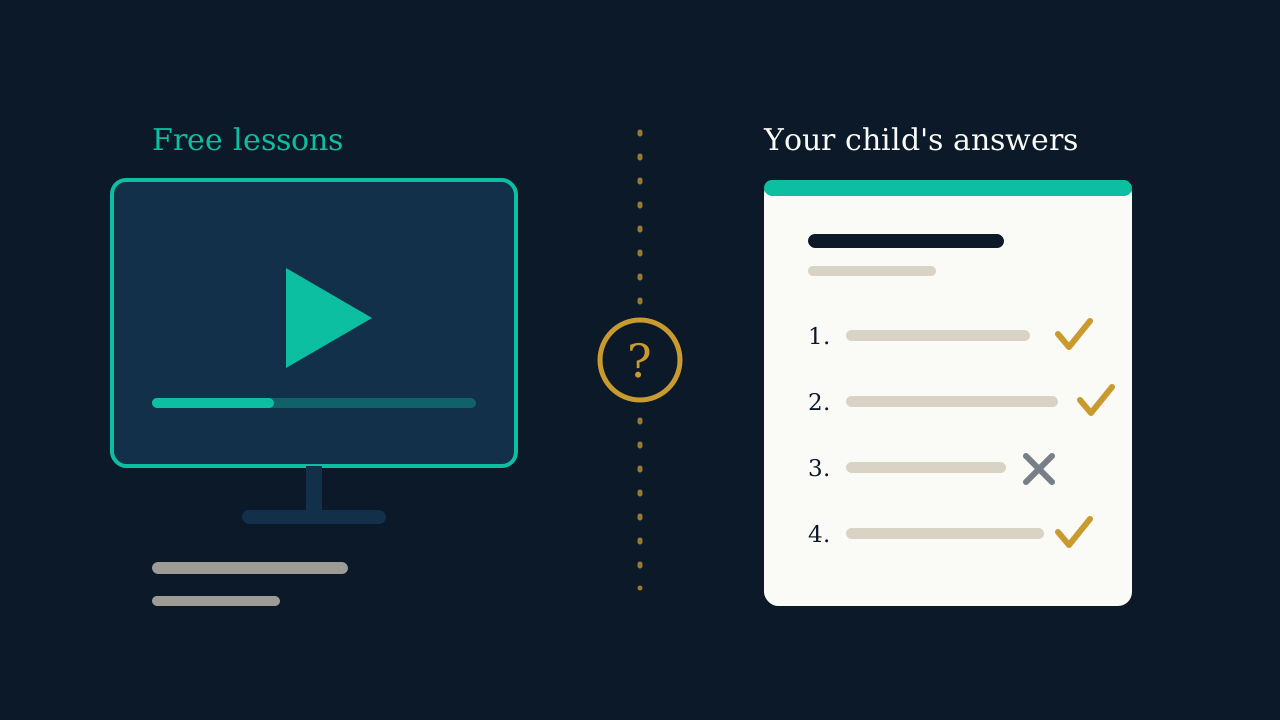
Before you look for a Khan Academy alternative, know what you would be giving up. As of September 2026 Khan Academy is free, has no ads, is a registered non-profit, and its India courses are built directly on NCERT chapters. For most CBSE families the honest answer is to keep using it. The reason to add something else is usually a different problem, not a better version of the same one.
What does Khan Academy actually give a CBSE family?
A full, free, NCERT-mapped course per class, with practice built in and progress tracked skill by skill.
Checked live in September 2026, the Class 5 maths course is titled "NCERT Math Class 5" and contains 66 skills across eleven units. The units are named after the NCERT chapters themselves: "Parts and wholes", "Tenths and Hundredths", "Smart charts", "How big? How heavy?", "Area and its boundary". Class 3 maths carries 57 skills on the same pattern. Every unit ends in a unit test and every course in a course challenge.
The organisation behind it reports 227 million registered users across 190+ countries and 55+ languages, and 840+ free courses covering K-12 and early college. Its India catalogue now runs wider than NCERT alone, with separate Maharashtra board tracks alongside the NCERT ones.
The only paid product is Khanmigo, its AI tutor, at $4 a month or $44 a year as of September 2026. The course library itself stays free, and the organisation is explicit about why.
Khan Academy's mission is to provide a free, world-class education to anyone, anywhere. Khan Academy is a 501(c)(3) nonprofit organization.
Khan Academy, "About us", accessed September 2026
That is a great deal of value at zero rupees, and no honest comparison starts anywhere else.
So why do CBSE parents search for an alternative?
Three reasons come up, and only one of them is really about Khan Academy.
It teaches, and sometimes teaching is not what is missing. Khan Academy is built to explain a concept to a child who has not understood it. If your child has already been taught long division at school and something is still going wrong, more explanation is not the diagnosis. It might be the treatment, but you do not yet know the disease.
The progress labels are not your report card's words. Khan Academy marks each skill Not started, Attempted, Familiar, Proficient or Mastered, with each skill worth 100 mastery points. Those words are precise and useful inside Khan Academy. They are not the vocabulary on a CBSE report card, which is why so many parents end up searching for what "mastered" and "developing" actually mean.
It is another screen. The Indian Academy of Pediatrics recommends under two hours of total daily screen time for children aged 5 to 10, counting educational apps in the same budget as everything else. A family that has already spent that budget is not looking for a better app.
None of these is a flaw in Khan Academy. They are reasons a family might need a second, different tool, or none at all.
What does a national average tell you about your own child?
Nothing. That gap is the actual problem, and it is worth seeing the numbers that make it obvious.
PARAKH Rashtriya Sarvekshan 2024, run by NCERT under the Ministry of Education, tested 22,94,377 students in 75,565 schools on 4 December 2024, across Grades 3, 6 and 9. The national report puts Grade 3 at 64% in Language and 60% in Mathematics. By Grade 6, Mathematics has fallen to 46%, the lowest of the three subjects assessed.
The competency tables are where it gets useful. At Grade 3, nationally:
| Competency (Grade 3 Mathematics) | Correct |
|---|---|
| Identifies and extends simple patterns | 69% |
| Sorts objects into groups based on more than one property | 68% |
| Performs simple measurements of time | 61% |
| Addition and subtraction of 2-digit numbers fluently | 58% |
| Multiplication as repeated addition, division as equal sharing | 54% |
| Recognises and classifies basic geometric shapes | 50% |
| Performs simple transactions using money up to INR 100 | 50% |
Half the country's Grade 3 children cannot yet handle money up to a hundred rupees. That is a striking national fact and a useless personal one. It does not tell you whether your child is in the half that can. Only watching your child answer those questions does.
This is also where to be careful. Persistent, unexplained difficulty with number work is a matter for your child's teacher and, if it continues, a qualified professional. No worksheet, app or website can screen for a learning disability, and none should claim to.
Khan Academy and a worksheet tool, side by side
All facts verified as of September 2026.
| Dimension | Khan Academy | LearnAlice |
|---|---|---|
| What it is for | Teaching a concept | Finding out what your child already knows |
| Price | Free, no ads, non-profit | ₹399 or ₹599 a month per child |
| Format | Videos and on-screen exercises | Printed worksheets, done in pencil |
| Range | Class 1 to 12, plus early learners | Grades 1 to 8 |
| Syllabus mapping | NCERT chapters, plus Maharashtra tracks | CBSE Learning Outcomes and Cambridge objectives |
| Progress vocabulary | Mastered, Proficient, Familiar, Attempted, Not started | Mastered, Still developing, Not practised yet |
| Adds to screen time | Yes | No, the child works on paper |
| Questions from your child's own textbook page | No | Yes, by photographing the page |
| Published efficacy research | Yes | No, and we will not imply otherwise |
Where Khan Academy is the better choice
Often. If any of the following is true, use Khan Academy and do not buy anything.
Your child needs to be taught. This is the big one. If a topic has not landed, somebody has to explain it, and Khan Academy explains it well, for free, in your child's language, as many times as they need. We do not teach at all. That is a deliberate boundary, not a gap we are working on.
Money is tight. A free NCERT-aligned course library with 66 skills in Class 5 maths alone is not a lesser product because it costs nothing. A household short on both cash and teaching should spend the cash on neither of us.
Your child is in Class 9 to 12. Our catalogue stops at Grade 8. Khan Academy runs to Class 12 and beyond.
You want an integrated single tool. Khan Academy teaches, practises, tests and tracks in one place, with one login. Adding a second tool adds a second thing to keep up with, and plenty of families should not bother.
You want evidence it works. Khan Academy publishes efficacy research. We have not run a study, so we have no equivalent number and will not borrow anyone else's.
There is no printer in the house. Printed worksheets need paper and ink. That is a real cost and a real constraint.
How should a parent choose between them?
Ask which of two questions you are actually stuck on, because they have different answers.
"My child does not understand this topic." That is an instruction problem. Khan Academy, DIKSHA, the class teacher or a tutor are the answers. A diagnostic tool will only confirm what you already know.
"My child's report card says Developing and I have no idea in what." That is an evidence problem. You need to watch your child work through questions at their level and sort the mistakes, which is what a marked worksheet does and what a video cannot.
Most families hit the second question after the first, not instead of it. Our guide on whether tuition is necessary in Classes 1 to 8 covers what to do when the answer is a person rather than a product.
LearnAlice answers only the second question. You pick a topic, or photograph the textbook page your child is on, and it prints a worksheet aligned to your board and class, from Class 5 maths through the rest of Grades 1 to 8. The graded answers come back as a skill-by-skill picture in the words your report card already uses. LearnAlice has no lessons, no videos and no tutors, and will never claim to teach your child. It tells you where they actually stand, on paper, so you know what to ask Khan Academy or the class teacher for next.
FAQ
Is there a better free alternative to Khan Academy for CBSE?
Not really, and that is the honest answer. As of September 2026 Khan Academy's India courses are free, ad-free and mapped to NCERT chapters class by class. DIKSHA, run by the Ministry of Education with NCERT, is the other genuinely free option and its QR codes are printed inside your child's textbook. Start with both before paying anyone.
Why would I pay for something when Khan Academy is free?
Only if you need something Khan Academy does not do. It teaches a child a topic. It does not hand you a per-skill picture of your own child in your board's report card vocabulary, and it does not work on paper. If neither of those is your problem, keep the free tool.
Does Khan Academy follow the CBSE syllabus?
Its India maths and science courses are built on NCERT, which is the textbook basis for CBSE. Class 5 maths, for example, uses the NCERT chapter names directly, including "Smart charts" and "Area and its boundary". CBSE schools follow NCERT books, so the mapping is close in practice, though Khan Academy is not a CBSE product and does not claim to be.
What does Khan Academy's "Proficient" mean on a CBSE report card?
Nothing directly. Proficient is an internal Khan Academy level, reached by answering every question on a skill correctly after first reaching Familiar. CBSE report cards use their own grading and descriptor scheme. The two vocabularies are not interchangeable, which is a common source of parent confusion.
Already using Khan Academy and still unsure where your child stands? Start a 14-day free trial, print one worksheet, and find out on paper. No card, cancel anytime.
AlternativesCBSEChoosing an edtech
Worksheets are the input. Clarity is the output.
LearnAlice turns every worksheet your child completes into a clear picture of what they've mastered, what's still developing, and the one thing to practise next — in your school board's own language.
Start free trial14 days free per child · no card needed