Worksheets · Textbooks · Practice at home
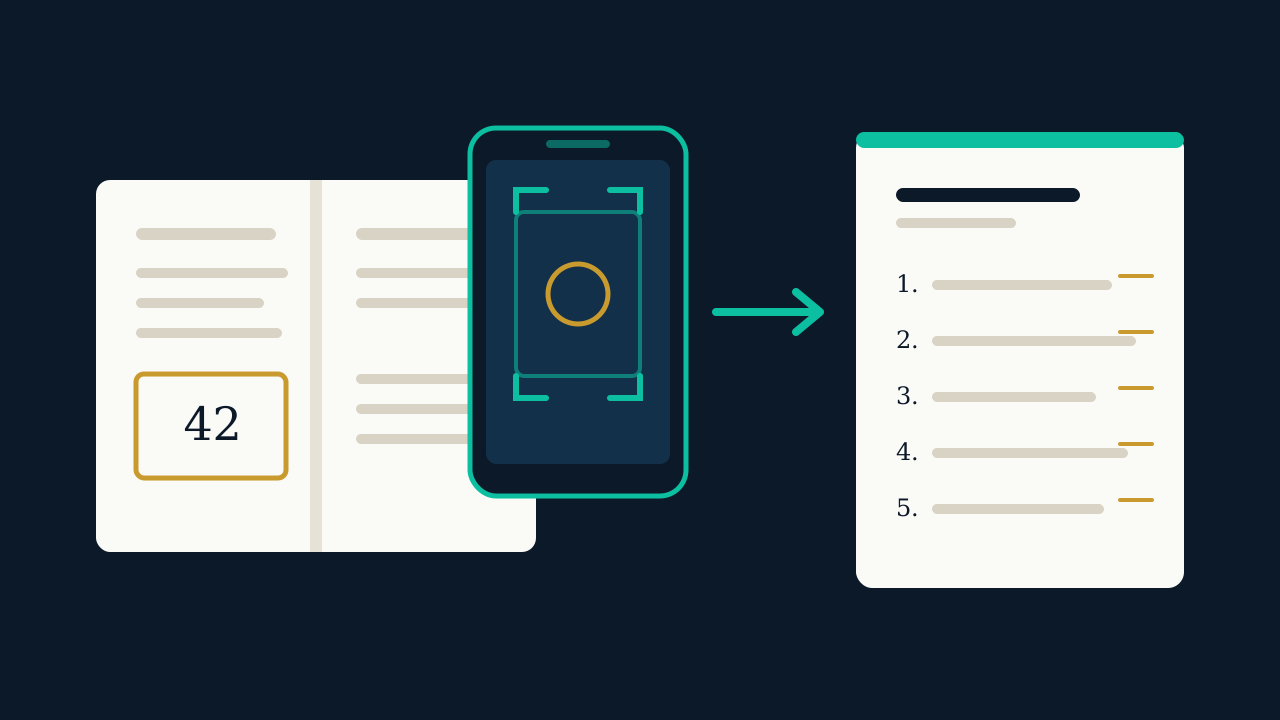
Photographing a page of your child's own textbook and generating practice questions from it solves a specific problem: the worksheet book you bought is organised around a syllabus, not around the chapter your child is actually on this week. The photo route starts from the real page. What it gives you is only as good as what you check, so here is how it works and where it goes wrong.
Why don't shop-bought worksheet books match my child's chapters?
Because the textbooks moved and most practice material has not caught up. NCERT has been replacing every school textbook in phases since 2023, and the sequence is on the record: Grades 1 and 2 in 2023-24, Grades 3 and 6 in 2024-25, then Grades 4, 5, 7 and 8 in 2025-26 (NCERT Bridge Programme, March 2025).
NCERT was explicit that this creates a mismatch for the children caught mid-way, which is why it published bridge programmes at all.
Grade 5 students may experience a gap in curriculum between what they studied in Grades 3 and 4 and what they will study in Grade 5. The same will be the case for Grade 8 students, who will get new textbooks but will have studied their Grades 6 and 7 curriculum with the old textbooks. Source: "From the Director's Desk", NCERT Bridge Programme for Grade 8, March 2025
If NCERT is bridging its own gap, a worksheet book printed against the previous syllabus is going to be off in places, and the chapter names alone will not tell you where. Cambridge Primary parents have a different version of the same problem: the learner's book your school picked is one publisher's route through the framework, and a generic practice pack is written against neither.
Meanwhile the page your child needs practice on is sitting open on the table. That is the argument for starting from the photo rather than from a catalogue.
How does a worksheet from a textbook photo actually work?
Three steps, and it is worth knowing which one is doing the work.
- Reading the page. The image is converted to text. Printed textbook pages under decent light are the easy case. Handwriting, faint photocopies and heavy diagrams are not.
- Working out what is being taught. This is the step that matters. The page has to be matched to a skill, for example subtraction with regrouping rather than "the sums on page 42".
- Writing questions at that level. New questions on the same skill, at a difficulty that suits the class, in the format the child's own papers use.
A tool that does step 1 and step 3 but skips step 2 gives you questions that look right and drift. They copy the surface of the page, so a page that happens to show three word problems produces three word problems, whether or not word problems are the thing your child is stuck on.
Step 2 is also what makes the output reviewable. If a worksheet is tied to a named skill, you can disagree with it. If it is tied to "page 42", you cannot.
Do I need anything besides the phone already in the house?
Almost certainly not, and the national data says so. The Annual Status of Education Report 2024 asked about this directly for the first time, in a rural household survey covering 649,491 children. Almost 90% of 14 to 16 year olds, girls and boys alike, reported a smartphone at home, and 82.2% said they knew how to use one (ASER 2024 national findings, ASER Centre).
Of those who could use a phone, 57% had used it for something educational in the previous week. So the device is in the house, the skill to use it is there, and the phone is mostly not being pointed at schoolwork.
One practical note for parents who came to this deliberately looking to keep the child off screens. The phone is the scanner, in your hand, for ten seconds. What lands in front of the child is paper. That distinction is the whole point for households that want practice without another app for the child to log in to.
What separates generated questions from useful practice?
Question generation from an image is no longer rare. As of September 2026 there are several general tools that will read a photo and produce a quiz from it, mostly built for teachers or for students revising alone. The gap is not the questions. It is everything around them.
| What you get back | A generic photo-to-quiz tool | Practice mapped to your board |
|---|---|---|
| Output | On screen, usually | Printed, done in pencil |
| Anchored to | The text on that page | A named skill in the board's own framework |
| After marking | A score | Which skill moved, which did not |
| Vocabulary used | The tool's own labels | The words on your child's report card |
| Across ten worksheets | Ten unrelated quizzes | A picture that accumulates |
The second column is what a parent can act on, because it survives the individual sheet. A score of 7 out of 10 tells you nothing next month. "Still developing on multiplication with regrouping" tells you what to print next.
This is the loop LearnAlice runs. You pick a topic, or photograph the page your child is on, and it prints a worksheet aligned to your board and class, from Class 5 maths through to Grade 4 (Stage 4) Cambridge maths. The graded answers build a skill-by-skill picture marked simply as Mastered, Still developing, or Not practised yet. LearnAlice does not teach your child and does not replace the school or a tutor. It tells you where your child actually stands.
What should I check before handing over a generated worksheet?
Read it yourself first, for about a minute. This is not optional, and any tool that suggests otherwise is overselling.
- Did it read the page correctly? Check one number and one instruction against the book. Diagrams, tables and Hindi or regional-language text are where misreads cluster.
- Is it the right skill? A page can mention four things and be teaching one. If the questions have wandered, the photo captured too much.
- Is the difficulty honest? Questions that are all easier than the textbook's own exercises will produce a confident child and a bad surprise in the test.
- Are the answers right? Work two of them yourself, including the last one, which is usually the hardest.
- Is there enough of one thing? Six questions on the skill that is wobbling is worth more than twenty mixed ones.
Practice also needs to come back. A skill practised once in September and never revisited is largely gone by November, which is the ordinary behaviour of memory rather than a failing in your child, and the reason children forget what they learn is worth understanding before you print anything at all.
FAQ
Can AI make practice questions from a photo of a textbook page?
Yes. The page is converted to text, matched to the skill being taught, and new questions are written at that level. Accuracy is good on clear photos of printed pages and drops on handwriting, faint photocopies and diagram-heavy layouts. Always check one number and one instruction against the book before your child starts.
Is it legal to photograph a textbook page for practice at home?
Photographing a page of a book you own, to generate fresh practice questions for your own child, is ordinary personal use. What is generated is new questions on the same skill, not a copy of the book. NCERT textbooks are also published free as PDFs on the NCERT website, so for those the page is already available to you.
How is this different from a CBSE worksheet book from the shop?
A printed book is fixed against one syllabus and one running order. Since NCERT replaced the textbooks for Classes 1 to 8 in phases up to 2025-26, older practice material can sit slightly off the current chapters. Starting from the page your child is on removes that guesswork, at the cost of you checking the output.
Which classes and boards does this work for?
LearnAlice covers Grades 1 to 8. The mapped competency catalogs are CBSE, using NCERT Learning Outcomes, and Cambridge Primary, using the published Learning Objectives for Stages 1 to 6. Children on ICSE or a state board practise against the shared NCERT spine rather than a board-specific catalog, which is worth knowing before you sign up.
The chapter your child is on this week is the one worth practising. Add your child, photograph the page, and print something aimed at it.
WorksheetsTextbooksPractice at home
Worksheets are the input. Clarity is the output.
LearnAlice turns every worksheet your child completes into a clear picture of what they've mastered, what's still developing, and the one thing to practise next — in your school board's own language.
Start free trial14 days free per child · no card needed