SOF Olympiad · Parenting · Exams
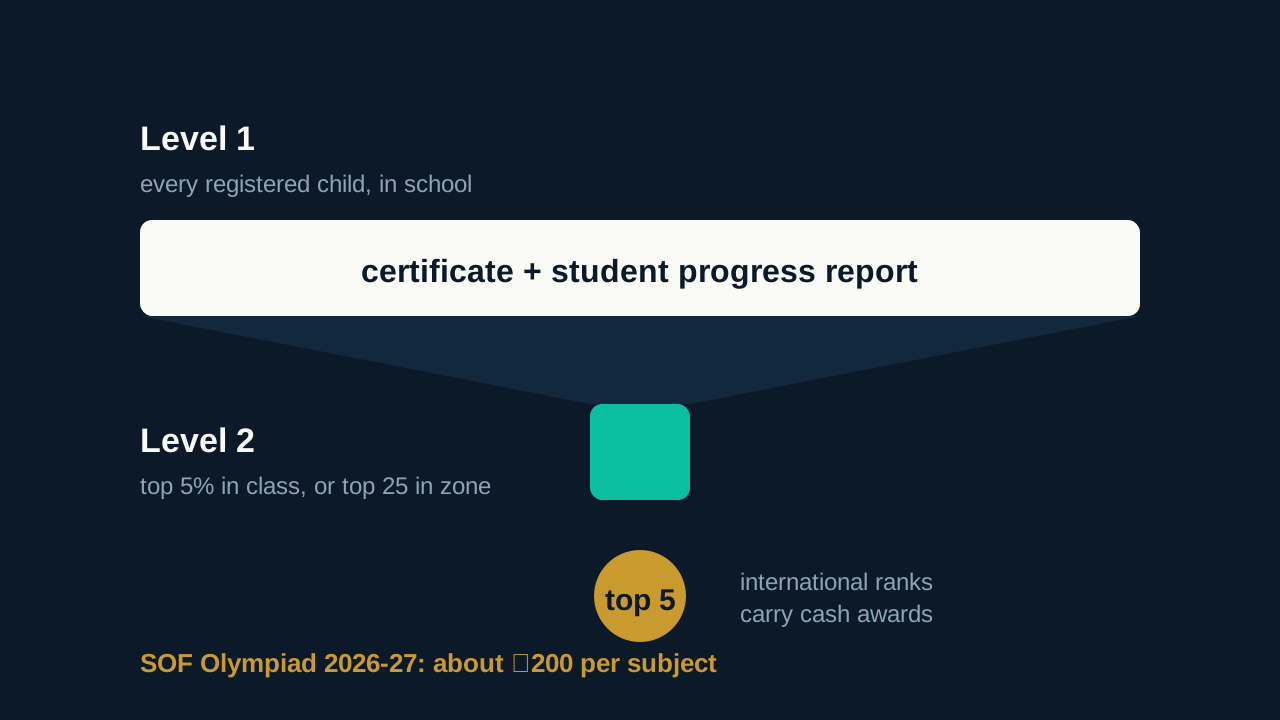
For most children in Classes 1 to 8, the SOF Olympiad is worth about what it costs, which is roughly ₹200 for one subject. It is a low-stakes exam written inside your child's own school, and every participant gets a performance report. It is not a scholarship route for the vast majority, and it is not the International Mathematical Olympiad.
Is the SOF Olympiad the same as the real International Mathematical Olympiad?
No, and this is the single most expensive confusion a parent can carry into the decision. They are two unrelated exams that share an abbreviation.
The SOF IMO is run by the Science Olympiad Foundation, a private foundation based in Gurugram, and it is open to Classes 1 to 12 through participating schools.
The International Mathematical Olympiad that India sends a team to is reached by a different ladder entirely. In India that ladder starts with the Indian Olympiad Qualifier in Mathematics, and its published eligibility criteria restrict entry to students "studying in Class 8, 9, 10, 11 or 12" (IOQM eligibility criteria, HBCSE, the most recent criteria published as of August 2026).
So if your child is in Class 3, no olympiad they sit this year is a rung on the route to the national team. That is not an argument against sitting one. It is an argument against paying for one because you believe it is a qualifying step, or letting a coaching seller tell you it is.
One naming change worth knowing: what most parents and most blog posts still call the NSO is now listed by SOF as the SOF ISO, the International Science Olympiad. The schedule and syllabus pages use ISO, while some older navigation links on the same site still say NSO (as of August 2026).
What does the SOF Olympiad actually cost?
₹170 per student per Olympiad, including GST, for schools in India, Bhutan and Nepal. Schools may add up to ₹30 per student for the coordinator's honorarium and related expenses, so about ₹200 per subject is the realistic figure (SOF registration fee, as of August 2026).
That is per Olympiad, not per year. A parent who signs up for maths, science and English is looking at roughly ₹600, and the schools that push all eight tend to be the ones where the total starts to matter.
Two exemptions are published: students with major physical disabilities, and Indian students whose parent was martyred during defence operations pay no fee.
For schools outside India, Bhutan and Nepal, SOF's fee page states US$11 per student per Olympiad plus up to US$1 for expenses. Note that SOF's own IMO FAQ page states US$12 for the same thing (as of August 2026). If you are in the UAE or elsewhere in the Gulf, take the figure your school gives you as the operative one and expect it to sit in that range.
There is no fee for a school to become a centre, which is why so many schools offer it. Offering the exam costs the school nothing.
How does my child register for the SOF Olympiad?
Only through the school. This is the rule that surprises most parents, and it is stated plainly:
Students can register for the SOF IMO International Mathematics Olympiad through their respective schools only. Individual registrations are not accepted. Source: SOF IMO FAQs, Science Olympiad Foundation, as of August 2026
Your school's coordinating teacher fills the registration forms and sends them to SOF, which generates the roll numbers. If your school does not participate, SOF's published route is for you to send it the school's details so it can approach the school. There is no way to walk your child in yourself.
The deadline is the part that catches families out. Schools choose one date per Olympiad from the published options, change of date is not permitted, and registrations go to SOF about 30 days before the chosen date. For the earliest maths date of 23 October 2026, that means the school's internal cut-off is somewhere around late September, and in practice schools collect money weeks earlier still.
The practical move: ask the class teacher or coordinator in the first week of September which dates the school has picked and when its own collection closes. Waiting for a circular is how the year gets missed.
When are the SOF Olympiad exams in 2026-27?
All level 1 exams are written in school, during school hours. Schools pick one date per subject (SOF exam schedule, as of August 2026).
| Olympiad | Dates (level 1) | Classes |
|---|---|---|
| SOF IGKO (general knowledge) | 22 Sep, 6 Oct, 3 Nov 2026 | 1 to 10 |
| SOF ICSO (computer science) | 24 Sep, 17 Dec 2026 | 1 to 10 |
| SOF IEO (English) | 30 Sep, 27 Oct, 17 Nov 2026 | 1 to 12 |
| SOF IMO (maths) | 23 Oct, 26 Nov, 10 Dec 2026 | 1 to 12 |
| SOF ISO (science) | 30 Oct, 19 Nov, 3 Dec 2026 | 1 to 12 |
| SOF IHO (Hindi) | 23 Nov 2026, 22 Jan 2027 | 3 to 10 |
| SOF ISSO (social studies) | 30 Nov 2026, 19 Jan 2027 | 3 to 10 |
Level 2 exists for IEO, ISO and IMO only, for Classes 3 to 12. SOF says those dates will be announced by December 2026, tentatively on the second or third Sunday of February 2027. IGKO, ICSO, ISSO and IHO are single-level exams.
Two things follow for younger children. Children in Classes 1 and 2 never sit a level 2 at all and are ranked on level 1. And the maths and science dates sit squarely in the half-yearly and post-half-yearly window, so read the calendar alongside your half-yearly exam timetable before adding three subjects.
What is actually on the paper?
Level 1 maths is 60 minutes. For Classes 1 to 4 it is 35 multiple-choice questions worth 40 marks, and for Classes 5 to 10 it is 50 questions worth 60 marks (SOF IMO syllabus and pattern, as of August 2026).
| Section | Classes 1 to 4 | Classes 5 to 10 |
|---|---|---|
| Logical Reasoning | 10 questions, 10 marks | 15 questions, 15 marks |
| Mathematical Reasoning | 10 questions, 10 marks | 20 questions, 20 marks |
| Everyday Mathematics | 10 questions, 10 marks | 10 questions, 10 marks |
| Achievers Section | 5 questions, 10 marks | 5 questions, 15 marks |
Two features of that table decide most of the "is it worth it" question.
A quarter of the paper is not school maths. Logical Reasoning carries 10 of 40 marks in the junior paper and 15 of 60 in the senior one, and it covers coding-decoding, mirror images, embedded figures, direction sense, analogy, and clock and calendar problems. A child can be excellent at school maths and score poorly here purely from unfamiliarity. That is a fair reason to buy one sample paper before deciding anything.
Forty per cent of the paper is last year's syllabus. SOF states that level 1 questions are 60% from the current class syllabus and 40% from the previous class syllabus. So a Class 5 child sits a paper where two questions in five come from Class 4 maths. If last year's work has gone soft, that shows up here before it shows up anywhere in school.
Who actually wins anything?
Almost everyone gets something, and almost nobody gets money. Both halves of that sentence are true and they get quoted selectively.
Every participant receives a Certificate of Participation and a Student Progress Report analysing strong and weak areas with comparisons at school, city, zonal and international level. For a lot of families that report is the entire return on the ₹200.
Qualifying for level 2 requires one of the following: being in the top 5% of candidates in your class internationally, being one of the top 25 rank holders in your class in your zone, or being your class topper in a school where at least 10 children from that class appeared and you scored at least 50%.
Read that last route carefully, because it is the reachable one. If only a handful of children in your child's class sit the exam, the class-topper route needs 10 appearing, and it does not open at all.
Cash sits further away still. SOF's published top awards for 2026-27 run ₹50,000, ₹25,000, ₹10,000, ₹7,500 and ₹5,000 for international ranks 1 to 5 (SOF IMO awards, as of August 2026). SOF says it spent over ₹24 crore across all its olympiads in 2025-26 on awards, scholarships, gifts and felicitations, spread across a participant base it describes as spanning 99,499+ schools in 72 countries.
Plan for the report and the certificate. Treat anything above that as a surprise.
So when is the SOF Olympiad worth it?
Three situations where the answer is a comfortable yes.
Your child finds school maths too easy and is bored. The Achievers Section is genuinely harder than school work, and an hour of unfamiliar difficulty in a low-stakes room is a cheap and healthy experience.
You want an external reading of where your child stands. School exams compare a child to 30 classmates. The Student Progress Report compares them more widely, and the comparison costs less than one tuition class.
Your child enjoys puzzles. Logical Reasoning is closer to a puzzle book than to a syllabus, and for the right child it is the best part of the paper.
When is it not worth it?
When the current class is not yet solid. An olympiad samples the top of the range. If your child is still shaky on this year's arithmetic, a paper that draws 40% of its questions from last year will produce a discouraging number and no useful action. Nationally, the proportion of Std V children who can do a three-digit by one-digit division was 30.7% in 2024, up from 25.6% in 2022, and for Std III subtraction with borrowing it was 33.7% (ASER 2024 national findings). Those are national figures across all school types, not a description of your child, but they are a reminder of how common an unsteady base is and how ordinary it is to fix it before adding competition.
When it is the school's target, not your child's. Some schools push registrations because the School Gold Medal of Excellence scales with how many children register per class. That is a school incentive. It is not a reason.
When your child is anxious about tests. Adding a competitive exam to a term that already has periodic tests and half-yearlies buys stress and no diagnosis.
If you are worried about a persistent difficulty rather than a one-off weak patch, an olympiad is the wrong instrument entirely. Start with the class teacher, and if the concern continues, ask for a referral to a qualified professional such as a paediatrician or an educational psychologist. A competition score cannot tell you anything clinical, and nothing on this page should be read as suggesting it can.
How should we prepare without turning it into a second school?
Buy one previous year's paper for the right class, sit your child down with it for the 60 minutes the real exam allows, and mark it. That single hour tells you more than a term of coaching brochures, and it is the honest test of whether the format suits your child at all.
If the reasoning section is where the marks go missing, that is a familiarity problem and a few sample papers fix most of it. If the maths sections are where they go, the fix is not olympiad practice. It is the ordinary syllabus, and specifically the parts of last year that faded.
That is the part LearnAlice is built for. You pick a topic, or photograph the page from your child's own textbook, and it prints a board-aligned worksheet in the vocabulary the school already uses, from Class 4 maths to Class 5 maths. Graded answers build a skill-by-skill picture marked as Mastered, Still developing, or Not practised yet. LearnAlice does not teach your child and does not replace the school. It tells you which skills are actually soft, which is exactly what a 40%-from-last-year paper is about to test. Reading the errors rather than the total is the same habit described in how to read your child's worksheet.
FAQ
Is the SOF Olympiad compulsory?
No. It is an optional exam that schools choose to host and parents choose to pay for. A school may present it as expected, but SOF's own rules make participation a per-student registration through the school, and no board requires it.
Can I register my child directly if the school does not participate?
No. SOF states that individual registrations are not accepted and that students register through their schools only. If your school does not offer it, SOF's published route is to send it the school and principal's contact details so it can approach the school directly.
Which class should a child start in?
There is no eligibility bar beyond the class range, which is 1 to 12 for maths, science and English. Classes 1 and 2 sit only level 1. Starting is a readiness question rather than an age question: if this year's syllabus is comfortable, the paper will be interesting rather than demoralising.
What is the Student Progress Report?
It is the report every participant receives. SOF describes it as analysing the student's strong and weak areas, with a performance comparison against other students at school, city, zonal and international level, plus an analysis of past years' performance for repeat participants.
Does an olympiad certificate help with school admission?
SOF publishes certificates, medals, and cash awards or scholarships for rank holders on its awards page, and makes no claim about admissions. Treat any admission-weight promise from a coaching centre or a book seller as their claim, not SOF's, and ask them to show you where it is published.
Want to know which parts of last year's maths went soft before the paper finds out? Start a 14-day free trial, print a worksheet tonight, and read the errors. No card, cancel anytime.
SOF OlympiadParentingExams
Worksheets are the input. Clarity is the output.
LearnAlice turns every worksheet your child completes into a clear picture of what they've mastered, what's still developing, and the one thing to practise next — in your school board's own language.
Start free trial14 days free per child · no card needed