Memory · Parenting · Learning science
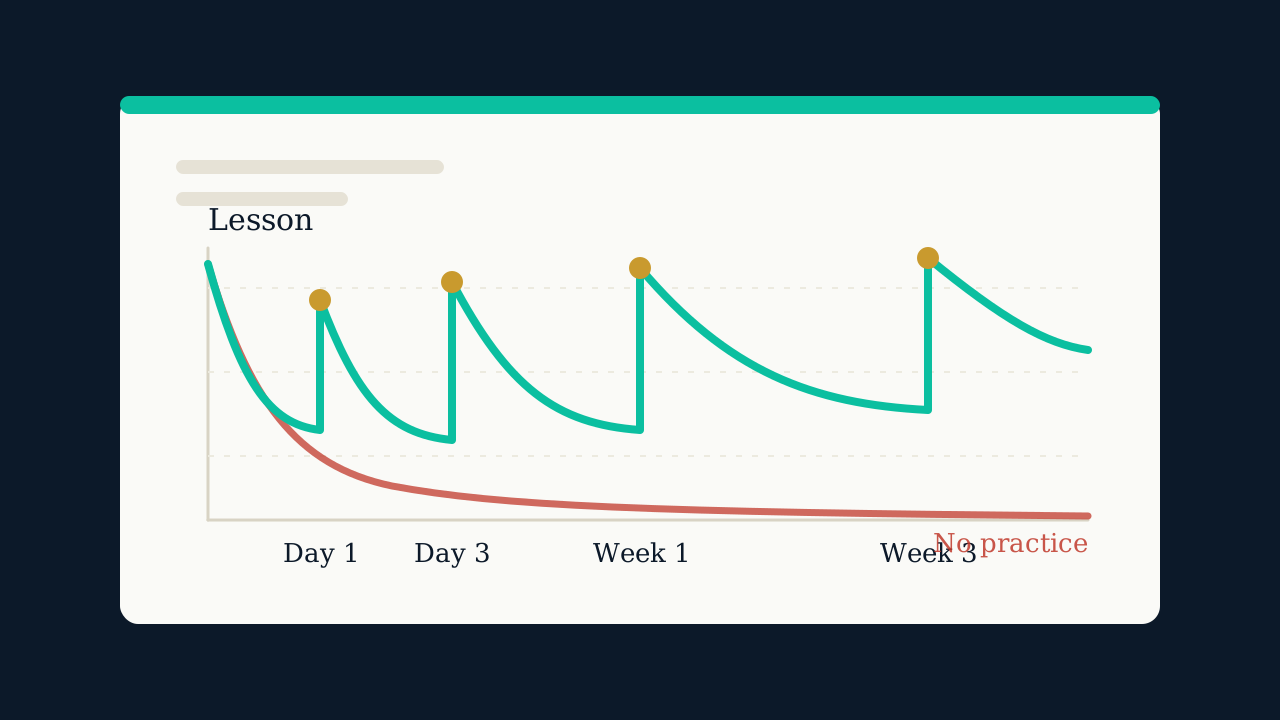
Forgetting most of what you learned is the normal behaviour of a healthy memory, not a warning sign. Researchers have measured the drop for more than a century, and it is steep within the first day. What changes the outcome is not more hours at the desk. It is when the practice happens, and whether your child recalls the material instead of rereading it.
Is it normal for a child to forget most of a lesson?
Yes, and the size of the loss surprises most parents. Hermann Ebbinghaus measured his own forgetting in 1880 using "savings", the share of the original learning effort a relearn no longer needs. Jaap Murre and Joeri Dros repeated the whole experiment and published the comparison in 2015.
| Time since learning | Ebbinghaus, 1880 | Murre and Dros replication |
|---|---|---|
| 20 minutes | 58.2% saved | 56.1% saved |
| 1 hour | 50.8% | 48.6% |
| 1 day | 42.2% | 44.0% |
| 2 days | 40.6% | 40.5% |
| 31 days | 20.9% | 4.1% |
Two things matter in that table. The fall is fastest at the start, most of it inside the first day, and then it flattens. And the curve held up when a different person repeated the study in a different language 135 years later (Murre and Dros, PLOS ONE, 2015).
So a child who cannot recall Friday's chapter on Monday is not careless and is not slow. They are behaving exactly like every measured human memory. The question worth asking is not "why did you forget", it is "what happened in between".
Why does my child remember at home but forget in the exam?
Because rereading builds confidence much faster than it builds memory. This is the single most useful finding for a parent who has watched a child revise all evening and still come home with 6 out of 20.
Henry Roediger and Jeffrey Karpicke ran the comparison directly. Students read a passage four times, or read it once and then recalled it from memory three times with no feedback and no chance to check. Five minutes later, the rereaders looked far better: 83% recalled against 71%. One week later the result had flipped completely, to 40% for the rereaders and 61% for the recallers.
The rereaders were also the most confident group of all, rating their expected memory highest at the end of the session, and they finished worst.
Testing is a powerful means of improving learning, not just assessing it. Source: Henry L. Roediger III and Jeffrey D. Karpicke, Test-Enhanced Learning, Psychological Science, 2006
At the kitchen table, with the book still open and the lesson an hour old, your child genuinely does know it. The exam asks for the same thing a week later with nothing on the desk to cue it. That gap is what the research above measures, and it is fixable.
What actually makes learning stick?
Two levers, and they cost no extra study time. The first is spacing the practice out instead of piling it up. The second is making the child produce the answer from memory before checking.
On spacing, the largest review of the evidence pooled 839 assessments from 317 experiments across 184 published articles. Splitting study into separated sessions beat cramming the same material at every delay tested: 47.3% correct on the final test against 36.7% for massed study. With a one-day delay before testing, it was 43.0% against 32.9% (Cepeda, Pashler, Vul, Wixted and Rohrer, Psychological Bulletin, 2006).
On retrieval, the same Roediger and Karpicke experiment measured how much each group lost over the week. The rereaders forgot 52% of what they once knew. The group that had practised recalling forgot 14%.
Neither lever asks your child to work longer. Ten minutes on Wednesday and ten on Saturday beats twenty minutes on Tuesday, and a covered page beats an open one. That is the whole mechanism.
What does forgetting look like across an Indian school year?
It looks like a skill that was genuinely learned in Class 4 and is missing in Class 8. The Annual Status of Education Report 2024 tested 649,491 children in rural households one-on-one, using the same tasks it has used since 2006.
- 33.7% of Class 3 children could do a two-digit subtraction with borrowing
- 30.7% of Class 5 children could do a three-digit by one-digit division
- 45.8% of Class 8 children could do that same division (ASER 2024 national findings, ASER Centre)
Read the last line slowly. Division is introduced years before Class 8, it is practised hard for a term, and by Class 8 fewer than half of children can still do it. Almost none of those children never learned it. Most learned it, passed something on it, and then never touched it again.
This is why a topic your child "did last year" deserves a five-minute revisit rather than an assumption. For a child in the middle of that division stretch, a short set of Class 5 maths worksheets on the one operation beats rereading the chapter. For an older child, the Class 8 maths worksheets map to the same NCERT Learning Outcomes the report card uses, so a gap shows up by name.
A spacing plan a parent can run in ten minutes
Keep it small enough to survive a normal week. The topic is one chapter or one skill, not a subject.
| When | What your child does | What you do |
|---|---|---|
| The day it is taught | Nothing extra | Nothing |
| Next day | Closed book, write down what they remember | Compare with the book together |
| Three days later | Answer four questions on it, book shut | Mark, note only what was missed |
| One week later | Redo only the missed part | Stop if it is right twice |
| Three weeks later | Two questions as a spot check | Log it as solid, or send it back a step |
Three rules make it work. The book stays closed until after the attempt, because looking first turns retrieval back into rereading. A wrong answer is information, not a reason for another lecture. And you stop practising a skill once it comes back correctly twice from cold, which is what stops this from expanding into an hour.
When forgetting is not about revision
Sometimes the pattern does not fit. A child who forgets instructions given two minutes ago, loses the thread mid-sentence, or shows the same difficulty across every subject and for months is telling you something that no revision timetable will address.
Ordinary causes come first and are worth ruling out honestly: short sleep, an undetected vision or hearing problem, hunger, anxiety about the subject, or a week of upheaval at home. If the difficulty persists across subjects and across months despite targeted practice, that is a conversation for your child's class teacher and then a qualified professional such as a paediatrician or an educational psychologist.
Nothing you do at home is a screening test. Worksheets show what a child can and cannot produce on paper. They cannot tell you why, and they cannot detect a learning difficulty. If you want a calm, structured starting point on where the skills actually sit, the 10-minute at-home check is a better first step than another evening of revision.
Tracking which skills come back cold, week after week, is the tedious part of all this. It is the part LearnAlice was built for: your child practises on paper, each graded worksheet becomes evidence against a named skill, and a topic that keeps fading shows up as "still developing" instead of hiding inside a mark out of twenty.
FAQ
Why does my child forget what he learns at school so quickly?
Because a memory that is never retrieved decays fast, and the steepest part of that fall is within the first 24 hours. Replicated measurements put the loss at more than half of the original learning within a day. One short recall session the next day, done with the book closed, changes the shape of that curve more than any amount of rereading.
Is forgetting a sign of a learning disability?
Not on its own. Rapid forgetting after a single exposure is normal memory working normally, in adults as much as in children. Persistent difficulty across every subject, over months, alongside trouble holding simple instructions, is worth raising with the class teacher and then a qualified professional. It is not something a parent can or should assess with worksheets at home.
How many times should my child revise a topic?
Four short contacts spread over about three weeks is enough for most primary topics: the next day, three days later, a week later, then three weeks later. Each one takes minutes, not an evening, and each should ask your child to produce the answer before checking. Stop once a skill returns correctly twice from a cold start.
Does rewriting notes help my child remember?
Much less than it feels like it does. Copying keeps the material in front of the eye, which builds a strong sense of familiarity and very little durable memory. Closing the book and writing down what can be recalled, then checking, uses the same paper and the same ten minutes and holds up far better a week later.
Practice only pays off when it comes back to the skills that keep fading. Add your child, print a worksheet on the one that keeps slipping, and see what is actually still there.
MemoryParentingLearning science
Worksheets are the input. Clarity is the output.
LearnAlice turns every worksheet your child completes into a clear picture of what they've mastered, what's still developing, and the one thing to practise next — in your school board's own language.
Start free trial14 days free per child · no card needed