Silly mistakes · Parenting · Learning science
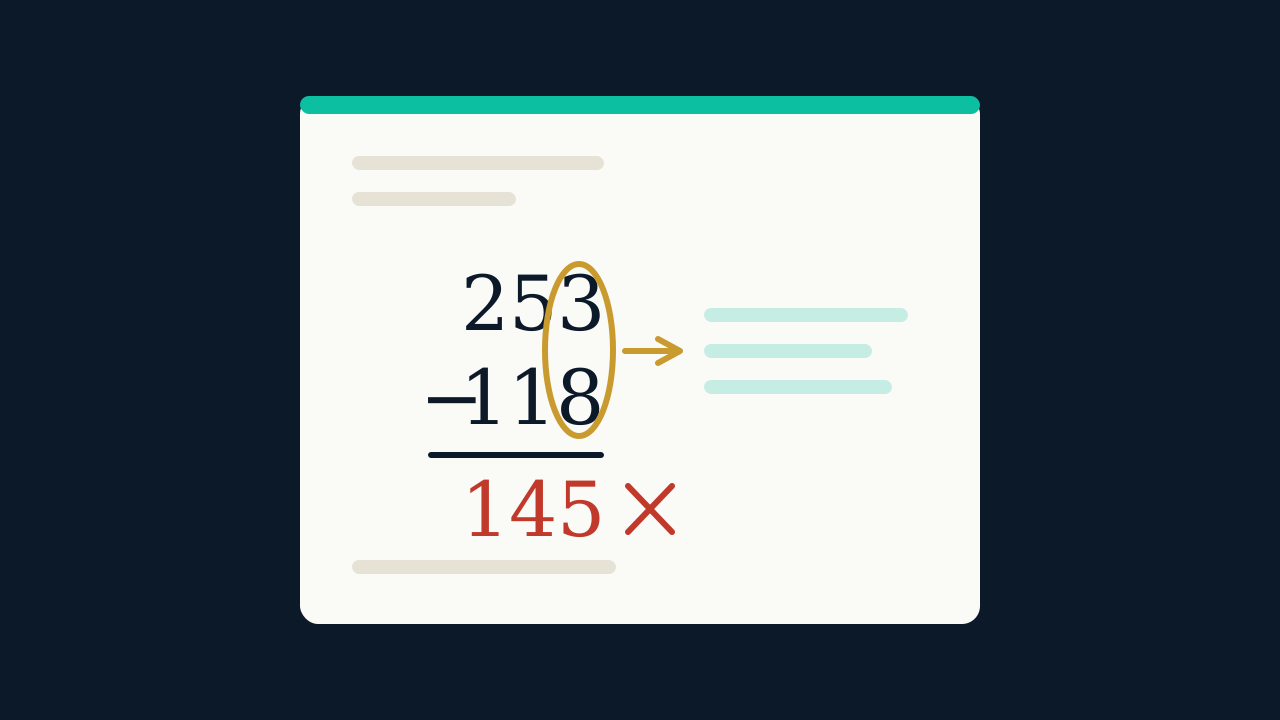
Most of what parents call a silly mistake in maths is not carelessness at all. When researchers catalogued thousands of children's wrong answers, they found the errors were not random: children were following a consistent but faulty rule, every single time. So the first job is not "be more careful." It is to sort the mistakes into two piles, because each pile needs a completely different fix.
What counts as a silly mistake in maths?
A genuine slip is an error where the child does an action they did not intend, and they can fix it themselves the moment they look again. The classic examples are copying 47 as 74, dropping a minus sign, or reading 6 as 9. Everything else that gets called silly is usually something else wearing a disguise.
The three piles worth sorting a paper into:
- Slips. The method is right, the hand or eye went wrong. Attention problem, not a learning gap.
- Misconceptions. The child applies a rule that is wrong but consistent. It looks like carelessness because the working is neat and confident.
- Blanks. Nothing attempted. This usually means "I did not know where to start," which is different again.
Sorting a returned paper this way is the whole habit. It takes five minutes and it changes what you practise next week. Our guide on how to read your child's worksheet beyond the score walks through the same sort on a single sheet.
Why most silly mistakes are not silly
In a landmark study at Bolt Beranek and Newman, John Seely Brown and Richard Burton analysed the arithmetic of 1,300 children in Classes 4, 5 and 6 and catalogued 55 distinct subtraction "bugs", each a small broken step in an otherwise sensible procedure (Brown and Burton, 1977).
Three of their documented bugs look exactly like carelessness on a report card:
| What the child wrote | What it looks like | What it actually is |
|---|---|---|
| 253 − 118 = 145 | A careless subtraction | Subtracting the smaller digit from the larger in each column, whichever is on top |
| 143 − 28 = 125 | A borrowing slip | Adding 10 to the top digit but never subtracting 1 from the next column |
| 140 − 28 = 120 | A random blank-ish answer | Writing 0 in any column that requires borrowing |
None of those children were being careless. Each was applying a rule with total consistency. Tell that child to "check your work" and they will check it, confirm it, and hand in the same answer.
Children's answers are "pieces of information which may reveal what the child is thinking," not just marks to be judged right or wrong. Source: J. A. Easley Jr. and Russell E. Zwoyer, quoted as the epigraph to Brown and Burton's report
How do you tell a slip from a misconception?
Use the researcher's own test, which takes about two minutes. Cover the answer, hand the same question back, and say nothing else. If your child gets it right on their own, the original error was a true slip. If they produce the same wrong answer again, or get stuck, it was never carelessness.
This is not a home invention. It is the method J. Clements used with 50 Class 6 students in 1982, re-interviewing them on questions they had answered correctly once and incorrectly another time. Judged this way, only 20% of student errors turned out to be genuinely careless, and over-confidence was the trait most associated with them (as summarised in San Pedro, Baker and Rodrigo's carelessness research, International Journal of Artificial Intelligence in Education).
Read that number the other way round: roughly 4 in 5 of the mistakes adults label careless are not careless. They are visible evidence of a specific idea the child has not finished building.
The same research found something counter-intuitive for parents of hard-working children. Careless errors were common among the students who were most engaged in their work, not the distracted ones. A child racing along confidently is exactly the child who skips the check.
Which habits actually cut down real slips?
For the smaller pile, the genuine slips, a few mechanical habits do help. Keep the list short enough that a nine-year-old will actually use it.
- Rough work in one place. A ruled margin down the right side, not scribbles around the edges. Most copy-back errors happen when the working is unreadable.
- Re-read the question after answering, not before. "Find the difference" and "find the total" get mixed up more often than any arithmetic step.
- Check by a different route. Re-doing the same steps the same way reproduces the same slip. Adding the answer back, or estimating roughly, catches it.
- One digit per box. Column errors in subtraction and long division are very often just misaligned handwriting.
Notice that none of these help with the bigger pile. A misconception survives every one of these checks, because the child performs them faithfully and still applies the broken rule.
What if the same mistake keeps coming back?
A misconception is invisible in a single sheet and obvious across six. If borrowing wobbles once, it was a bad day. If it wobbles in the same place three sheets running, that is a specific skill to practise, not a lecture about concentration.
A third possibility is worth ruling out before either: the method was learned properly months ago and has simply faded since, which is ordinary memory rather than a broken rule. Our guide on why children forget what they learn covers how to tell a faded skill from a wrong one, and how much spacing it takes to hold.
The national picture says this is ordinary, not alarming. In the Annual Status of Education Report 2024, a rural household survey of 649,491 children, 33.7% of Class 3 children could do a two-digit subtraction with borrowing, and 30.7% of Class 5 children could complete a three-digit by one-digit division (ASER 2024 national findings, ASER Centre). Borrowing and division are where the documented bugs cluster, and they are where most Indian children are genuinely still building.
So practise the one step, not the whole chapter. For a Class 3 child stuck on regrouping, a short set of targeted Class 3 maths practice worksheets on that single competency beats another twenty mixed sums. For division and place-value bugs later on, the Class 5 maths worksheets map to the same NCERT Learning Outcomes your child's report card uses.
Tracking that pattern by hand across weeks is the tedious part, and it is the part LearnAlice was built for. Your child practises on paper, and each graded worksheet becomes evidence against a named skill, so a recurring bug shows up as "still developing" on one competency instead of hiding inside a score out of ten.
When silly mistakes are not really about maths
Sometimes the pattern does not fit either pile. The child can explain the method aloud, gets it right at the kitchen table, and still loses marks in every test. Common and usually fixable causes include time pressure, reading the question under stress, or simply not having written enough papers at exam pace.
If the difficulty persists across subjects and across months despite targeted practice, that is a conversation to have with your child's class teacher and, if it continues, with a qualified professional such as a paediatrician or an educational psychologist. Worksheets show you what a child can and cannot do on paper. They cannot tell you why, and nothing you do at home should be treated as a screening test for attention or learning difficulties. If you want a calm starting point on where your child's skills actually sit, the 10-minute at-home check is a better first step than another timed test.
FAQ
Why does my child make silly mistakes only in the exam?
Usually pace, not knowledge. Under time pressure children skip the written steps they use at home, and errors move from the page into their head where they cannot be seen or checked. Practising a few papers at exam speed, with rough work still written out, fixes more than any reminder to be careful.
How do I stop my child rushing through the maths paper?
Give the last five minutes a job. "Check everything" is too vague to act on, so pick one concrete task: re-read every question word for word, or re-total one sum per page by a different method. Research links careless errors to over-confidence, so a specific closing routine works better than telling a confident child to slow down.
Are silly mistakes a sign of a learning problem?
Not on their own. Persistent, consistent errors are far more often an unfinished idea about one procedure, and they resolve with practice on that exact step. If difficulty continues across subjects for months despite targeted practice, raise it with the class teacher and a qualified professional rather than trying to assess it at home.
At what age can a child check their own work?
From about Class 3, if the check is a concrete step rather than a general instruction. Younger children can manage one rule, such as re-reading the question. By Classes 6 to 8, checking by a second method, like estimating the answer first, becomes realistic and is the habit that lasts.
Practice only pays off when it targets the right step. Add your child, print a worksheet on the skill that keeps wobbling, and see which pile the mistakes really belong in.
Silly mistakesParentingLearning science
Worksheets are the input. Clarity is the output.
LearnAlice turns every worksheet your child completes into a clear picture of what they've mastered, what's still developing, and the one thing to practise next — in your school board's own language.
Start free trial14 days free per child · no card needed